Natural gas is too "unstable" to use on our roads and highways where
millions of cars and trucks are subject to the millions of traffic
accidents. From a safety perspective alone, natural gas vehicles should
not and cannot be allowed on our roads. There are simply too many
uncontrollable variables.
Natural gas can however, power the
transportation of the future as feed stock for electrical power
generation. Because natural gas is so abundant, it only makes commons
sense that electric power plants will use more and more natural gas as
their feed stock over time. As this abundant source of power generation
comes on stream, look to invest in the companies that stand to benefit
from this game changer.
Duke Energy (DUK), Progress Energy (PREX.PK) and others are all good bets as is laid out by theStreet.com (See their top ten list for 2012)
Electric power storage is also a great place to take a long term view.
There companies in that space looking for fuel cell solutions (large
fuel cell stacks that can burn nat gas) Ballard Power (BLDP), Plug Power (PLUG), and Hydrogenics (HYGS)
are all pursuing such a solution. However, it is the feed stock of the
future electric car that interests me most, and that is Lithium.
As
Lithium becomes more and more the "go to" source for new battery
technologies, from your iphone and laptop, to golf carts, electric motor
cycles, cars and large storage facilities, look to the miners who
produce, or will produce, lithium carbonate from two different sources,
hard rock (pegmatite) and lithium brines or clays. Let me explain.
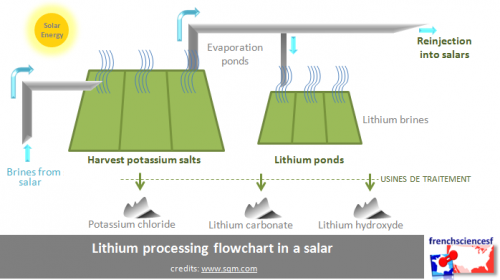
The largest supplier of Lithium today is Sociedad Qumica y Minera de Chile S.A. (SQM)
which produces Lithium as a byproduct of its massive Potash operations.
As with other large miners, SQM sells it's lithium on a spot market
(there is currently no futures market for lithium, however this could
change in the coming years)
Now electric battery manufacturers and
car makers require a steady stream of lithium carbonate for their
manufacturing processes so as not to interrupt production. To date,
suppliers such as SQM, FMC et al have refused to sign
contracts to supply a continuous, uninterrupted supply of product to
manufacturers. This is mainly because, even though brine production is
the most economical way to produce lithium, it is more sporadic than
spodomen production, due to the natural drying out process supplied by
the sun, that makes it more economical in the first place.
Australian producer Talison Lithium (TLTHF.PK)
(TLH-T) is the largest, pure lithium producer on the planet, and its
spodomen production from its Greenbushes operation in Western Australia,
is the richest hard rock deposit on the planet. Talison supplies over
300 customers with product and is the largest supplier to the growing
Chinese market, due to its ability for continuous production and its
proximity China. Talison also boasts a very large brine deposit in South
America due to its purchase of Salares Lithium in 2010. In 2012 Talison
reports a 25% increase in the price of lithium this year alone (2012). (click to enlarge) FMC Corporation (FMC)
is another large producer based in South America, with brine production
as a byproduct of other operations such as potash. As with SQM, lithium
is only a part of its total operations and as potash becomes more
important as agriculture attempts to feed a hungry world, its share
price looks attractive as well.
As the lithium market grows, you should not ignore the juniors
who have popped up over the past five years to take advantage of large
deposits which may at some point, be quite productive or gain the notice
of larger producers as consolidation takes place, as it so often does
in young, growing markets.
In this space I like both Western Lithium (WLCDF.PK)(WLC-T) for its large, Kings Valley clay deposit in mining friendly Nevada and Rodinia Lithium (RDNAF.PK)
(RM-T) as it owns three of the top 20 lithium brine deposits on the
planet. If there is a future consolidation in the industry, these two
should be tops on the majors lists.
In the "Battery" tech area I like A123 Systems (AONE).
At only .50c per share this high tech battery maker has been hammered
this year, well below where I think it should trade. At .50c per share,
it is one of the best speculative penny stocks out there.
The
above chart shows some of the other companies working in this field and
as you can see from the chart, Lithium is a common denominator in
battery development.
UPDATE: Aug 24th 2012
Rockwood Holdings (ROC) made an offer for Talison Lithium of $724 Million driving Talison shares up by 53% since yesterdayès close. We have cashed out our position in Talison with 110% gain. Looking for an entry point into ROC now as it strengthens itès already substantial position as a world leader in the production of Lithium!
In these pages, I have written a number of articles about the coming lithium boom, the electric vehiclebattery market, and the companies who are either mining lithium at present, or are rushing to become new producers of what has become known as the Èlectric Metal. In point of fact, lithium is becoming one of the few truly bull markets for savvy investors today.
Right: One of the two operational lithium plants in Greenbushes Australia belonging to Talison Lithium Ltd. which have been operating for 25 years and currently supply 300 companies with lithium and lithium carbonate. Talison, up to this month a privately owned company, supplies approx 66% of Chinas imports of lithium.
The United States Department of Energy announced in January 2010, that 24 million hours of supercomputing time at Argonne National Laboratories and Oak Ridge National Laboratories were awarded to investigate materials to develop advanced lithium-air batteries.
This effort, which is utilizing two of the most powerful super computers on the planet to construct a battery that will power electric vehicles over 500 miles on a single charge, is a classic example of how government and private enterprise can work together for the betterment of everyone.
This partnership between government's "super computing" ability, and the private sector, occurred as a direct result of two visits to these Labs by IBM's VP of Research in 2009. A consortium of scientists from IBM, Argonne National Laboratories and Oak Ridge have, at this writing, have developed a break through in Lithium-air technology that is said to increase energy storage by tenfold over today's more ubiquitous lithium-ion batteries. In other words, electric cars will be able to travel farther on one battery charge than most current vehicles, whether hybrid of gasoline powered, can today.
This is only one of the many projects underway to enhance lithium batteries for the coming boom in electric vehicles. At this writing, there are hundreds of scientists, electrical engineers, technicians and lab rats all over the world, from China to Chile, racing to bring their own inventions in energy storage to market, however they all have one element in common, and that is lithium. Whether it is lithium-air batteries, lithium-ion, lithium metal, or whatever catalyst is used, the common denominator is lithium carbonate.
The mining of lithium carbonate, and the rush to secure deposits of lithium brine in Chile, Argentina, Bolivia and China, is the reason that the electric metals market is heating up. Junior miners are getting swallowed by bigger players. Auto companies such as Toyota, Honda and Ford, and auto parts manufacturer Magna International, have all bought in to lithium miners in the past year, so as to secure a future supply of this vital metal.
Isn't it time you considered these investments for your retirefund?
HP
Vancouver, BC -- June 04, 2010 -- (TSXV: LIT). Salares Lithium Inc. (the "Company") is pleased to provide an update on the Salares 7 project in Region III, Chile (the "Project").
Project Update
The Company is pleased to report that it has signed a 3,000 metre diamond drill contract with Terraservices of Santiago, Chile. The program is designed to test selected parts of the interpreted brine bearing horizon (reservoir rock) at the Salar de la Isla, a brine lake 26km long and on average 6km wide. The depth of the known interpreted brine bearing horizon is less than 300 metres. Aquaconsult of Santiago, Chile, a hydrological consulting firm, will assist the Company and Terraservices with the drill program protocol and sampling.
Drilling will begin once the base camp near to the Salar de la Isla is completed. P.K. Mendies of Santiago, Chile, has been contracted to construct and be responsible for the 25-30 person winter camp. Completion of the camp was delayed as a result of unusually heavy snowfall in the last two weeks which did not allow for the delivery of materials and winterized containers.
As a result of a break in the snowfall and as of yesterday, our local Chilean partners have recovered their equipment in the area and have now begun clearing the road of snow and finalizing access to the camp. Once access has been restored, the camp will be completed and the drill program initiated.
"While we are all frustrated by the weather delay, management is determined to advance the exploration program as fast as is safely possible. Both the General Manager (Chile) and the V.P. Exploration will be onsite early next week to oversee the camp construction and get the drilling phase initiated immediately thereafter", commented Todd Hilditch, CEO.
Salares Lithium Inc. is a lithium explorer in Chile that controls the 'Salares 7' lithium project made up of seven salares (brine lakes that are prospective for sub-surface lithium and potassium) and the surrounding concessions in Region III, Chile. Five of the seven salares are clustered within 155 kilometres and are 100% owned by the Company and its Chilean partner.
FOR FURTHER INFORMATION PLEASE CONTACT:
Todd Hilditch
President and CEO
Tel: (604) 443-3831
Oil circa 1909, plastics circa 1955 and Lithium in 2010. Lithium will store our power generated from wind and solar. It will power electric vehicles and improve hybrid plug-in vehicles. It is starting to power the mobile web (smart phones, iphones, ipads, note books and laptops). Every battery used for electric vehicles will require 8 pounds of lithium! We are now invested in six lithium mining stocks. Here are some of them, and the reasons why!
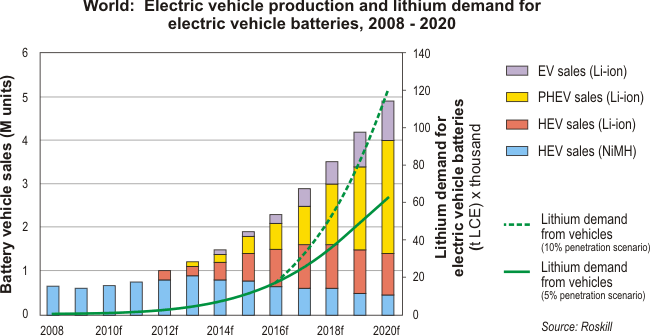
From Ford to Toyota, GM to Honda, and Nissan to BYD , from China to Chile and everywhere in between, auto companies are searching the globe and scrambling to secure their future supply of this commodity as the electric car is about to re-emerge after a 100 year hiatus.
Lithium is used in lithium-ion batteries, (and many new forms of Lithium batteries such as Lithium air, Lithium sulfur etc) glass ceramics, greases, steel, nuclear energy and pharmaceuticals, however, it is the advent of Lithium use as the best material for energy storage in batteries made for the Hybrid and electric vehicle market, that is causing one of the big bull markets of this decade. From Buses to cars and trucks, and every type of vehicle in between including vehicles such as fork lifts, ATV's, motorized bicycles (as in the billion or so made in China and India) skidoo's, seadoos, and everything else that moves, companies are building better electric batteries for these vehicles, and the overwhelming winner of the commodity race is, you guessed it, LITHIUM!!
Buying into a good Lithium play today would be like investing in oil at the turn of the 20th century, or plastics in the 1950's. It will have that much of an impact as the electric car and hybrid plug-ins become more and more common. The explosion in batteries using Lithium Ion technology, Lithium air technology, lithium sulfur or any number of other Lithium based materials currently being researched and produced is occurring so fast, that fortunes will be made, and indead, are already being made.
Scientists, technicians, engineers and lab rats all over the world, are developing lithium energy storage products at this writing. Lithium carbonate is the best element for storing electricity, period. When compared to current technology such as nickel metal hydride batteries, Lithium is twice as light, produces 3 times the power and keeps it's charge up to 5 times longer. Lithium won't just be used for electric vehicles, hybrids, cellphones and laptops including tablet computers, but also on a larger scale, for wind farms and solar farms where energy storage is absolutely crucial to the future of electrical grid technology.
China, recently announced it will stop shipping Lithium and rare earth enements (REE's) to other countries. China sees an opportunity to try and corner the Lithium market while America and Europe are still fending off financial problems and to this end, it has been trying to butter up the left wing government in Bolivia which may hold 50% of the Lithium deposits on the planet. Problem is, Bolivia is a quagmire of political problems for anyone trying to enter the Lithium market there as the president is not receptive to international companies. He wants to develop Bolivia's Lithium deposits "in country". another problem is that this Lithium deposit, while very large, will be expensive to develop because of the large amounts of magnesium and other compounds in the brine.
Other locations for Lithium mining are in hard rock formations(Canada-Quebec), clay formations (Nevada) and in Salars or salt Lakes. (Besides the big deposits in Bolivia, Chile (which currently supplies 60% of the worlds Lithium), as well as Argentina) It is the extraction of Lithium and Potash fromSalars that is the easiest, and cheapest way to mine this very "in-demand" resource.
Today, 60% of all Lithium is produced in the country of Chile!
Chile is really the epicenter of the Lithium boom notwithstanding Bolivia and Argentina, the two other countries that share the Puna Plateau.
The Salar flats of the Andes on the Puna Plateau, contain millions of tons of Lithium carbonate totaling 84% of the worlds known reserves.This Lithium is also the easiest, and cheapest Lithium to extract, as the sun does most of the work, in this, the driest area on the planet.
According to one of the foremost Lithium experts, R. Keith Evans, "Because Mother Nature does most of the work in producing lithium carbonate in this region, it is the greenest source of lithium we know of".
Any other source requires significantly more energy for processing, thus increasing the price." (read hard rock sources) Add to that the fact that Chile recently elected a conservative government that is very friendly to the mining community, and you have the making of a full blown, 5 alarm, bull rush into the Chilean Salar flats by a number of Juniors. Nevada also has similar, but smaller, lithium resources.
Canadian Juniors are leading the way in this boomand they offer the best investment "bang for your buck" so to speak, as investors wake up to the fact that Lithium will power the future of most automobiles. Currently, the top producer of Lithium from the Chilean "Puna Plateau" is Sociedad Quimica y Minera (SQM). To date, their Lithium production has been a by product of the potash which they mine there, and their stock price is already through the roof. In 2010 they are increasing their production of Lithium to meet increased demand worldwide.
Here are our picks in the Lithium junior miner sector, in order, based on the size of deposits identified, and the purity of the Lithium carbonate to be mined.
PURE LITHIUM PLAYS
1.Salares Lithium (LIT-TSX)owns over 117,000 hectares (288,990 acres approx) in the Atacama region of Chile, encompassing 7 Salars (brine lakes). It is one of the best, pure play Lithium ventures anywhere today with a depth of resource between 170 meters and 300 meters in a region that already produces 50% of the worlds current lithium supply. In fact, SQM, the largest producer of lithium in the world today, may actually be interested in some or all of Salares Lithiums concessions due to their close proximity and the purity of the resource.
Salares Lithium wholly owns 100% of 5 of those Salars, which is unique in the industry and very important in South American mining. Many others "share" deposits on the same properties. Salares now has a giant Lithium footprint, as large as anyone on the planet (read the article: Size matters ) They also have a very focused management team and institutional investors are in on this play.Now SQM may be interested. Analyst opinions on Salares Lithium!
2. Western Lithium (WLC-TSX)owns over 50,000 acres of proven, lithium reserves in Nevada. One of the only Lithium pure plays in the USA with proven reserves. This is one of the worlds largest, proven Lithium deposits at 47 million tons, mine ready, located in mining friendly Nevada with quick access to buyers in North America. Western Lithium should make any lithium investors portfolio. On May 31st Western Lithium will change it's name to Western Lithium USA to more reflect it's intention to supply Lithium to that market. (update- we recently sold our shares in WLC, at a profit of course, to free up cash for the purchase of more Salares Lithium shares)
LITHIUM,GOLD AND RARE EARTH METAL PLAYS
3. The biggest "sleeper" in the space is TNR Gold Corp (TNR-TSX) which is currently flying under the radar of most investors. TNR Owns 16 gold, copper, Lithium, and REE properties in Nevada, Canada, Argentina and Ireland. More importantly, TNR "owns 100% of International Lithium Corp" (ILC) which it will spin off next month in an IPO.
ILC own 9 Lithium brine properties in Argentina, Nevada and Canada, while TNR will retain it's gold, copper and rare earth deposits in Canada and Ireland as well as one Lithium play in Argentina. TNR may actually be the best "short term" play in the sector as it prepares the IPO for International Lithium Corp. as owners of TNR stock will automatically own stock and warrants in International Lithiumwhen it is spun out next month. (one share and one warrant for every 4 shares of TNR) Thereby owning "both" companies after the IPO next month. Institutional Holders of TNR stock include some serious players:
Barrick Gold, Pinetree Capital, Tocqueville Fund, Solitario, and NovaGold.
4. Latin American Minerals Inc. (LAT-TSX)Besides gold, copper and silver, LAT owns a 17.4% stake in Lithium Americas Corp. (LAC) which has a big stake in the Salars on the Argentina side. LAT also owns rare earth properties (REE's). Lithium Americas properties include over 100,000 Hectares encompassing 5 salars (salt lakes) on the Argentina side of the Puna Plateau.You can buy LAT now (currently .20 cents) to own 17.4% of Lithium Americas, (which we have done), or you can buy Lithium Americas (LAC) at the IPO price of $1.80 Strategic Investors in Lithium Americas already include:
Magna International Inc.
Mitsubishi Corporation
PineTree Capital corp.
5. Rodina Minerals (RM-TSX) Besides it's recent acquisitions of Diablillos, Centenario and Ratones in the Salars of Argentina on the Puna Plateau, RM owns a substantial lithium property in Clayton Valley Nevada Rodinia has 100% mineral rights to 50,440 acres in Nevada’s lithium-rich Clayton Valley in Esmeralda County and is currently in the process of assessing the size, quality and processing alternatives of its Lithium Brine Project. Early estimates put the valley’s lithium deposits as high as 700 million kg, ranking it second only in size to the deposits found in Chile.. RM is one of the top Lithium picks of Byron Capital Markets analyst, Dr. Jon Hykawy who is, arguably, one of the foremost Lithium experts in the market today! RM is also a favorite of the gold report.(theaureport.com)
At this writing, all of these stocks can be had for under $1 per share.
There is truly a "fire sale" on these market go-getters who have staked their claim in the Lithium rush of this decade and stand to reap huge rewards for their efforts.
You can invest in the battery companies, (who are battling it out in the technology department) the electric car companies, or the mobile web device makers like Apple, and they are indeed good bets. However, they all need the raw product, and that is Lithium, specifically it is lithium carbonate. The companies listed above with properties in Chile and Nevada, are in the drivers seat as these deposits are already known, are enormous, and will be processed at the lowest cost, because the sun provide most of the energy needed for production, in the driest, most arid places on earth.
The lithium boom will last for at least the next 10 years. As many investors make their fortunes from this 21st century boom, I hope that you are one of them. I certainly intend on being one. Here's to your retirefund!
Lithium (Li), the first of the alkali group of metals, was discovered (1817, Sweden) by Johan August Arfvedson and named for the Greek lithos, “stone.” A soft, silvery metal, it has many uses, including the production of glass, lithium batteries, and a strong, light alloy with aluminum for airplanes. Lithium carbonate is used in the treatment of mental illness, and an unknown amount is used as lithium hydride in the production of nuclear weapons.
Besides being used in most mobile web smart phones, laptops and ipads etc, Lithium Ion Batteries are the best technology for electric, plug in cars according to industry insiders and mining companies are now rushing to fill a void in an industry that is still in it's infancy, but is about to explode. That is the electric car industry.
As Warren Buffet points out, "In 20 years all cars will be electric"! Obviously that is one of the reasons Warren invested last year in Chinese car maker BYD.
However, the story here is Lithium mining, where it is mined, and And how it is mined. The Nickel Hydride battery, currently used in many hybrid vehicles, is grossly insufficient to power electric plug in vehicles (EVs) and, until now, this has been a major road block in developing EVs that can compete with the gasoline engine or Hybrid technology. If you review all of the battery blogs, and science and energy sites, it becomes clear that thousands of scientists and technicians around the world are working on Lithium batteries. Whether it is lithium vanadium phosphate that BYD Company Ltd. (BYDDF.PK) in China is researching, Lithium Ion, Lithium cadmium, Lithium Manganese, Lithium polymer or Lithium iron phosphate, the keyword in new battery technology is overwhelmingly, "Lithium"!
Lithium is also currently used in a number of applications including as a power source for mobile web devices (smart phone batteries - which are expected to triple by 2012), heat resistant glass and ceramics, Health care (Lithium based mood stabilizing drugs), and Lithium batteries for EVs, which may outdistance their closest competitor, Nickel Hydride batteries, in pure power, by a factor of 10. Lithium is also used nuclear energy and lithium hypochlorite is used extensively in cleaning swimming pools. There are truly many, varied uses for this valuable commodity.
Lithium is soft enough to be cut with a knife, and it is the lightest of the metals of the periodic table. It also has a low density (approximately 0.534 g/cm3) and thus will float on water, with which it reacts easily. It is most easily mined from Salar or salt lakes, mostly found in Bolivia and Chile.Lithium salts are extracted from the water of mineral springs, brine pools and brine deposits. It can also be mined from rock but that is more difficult and more expensive. Canadian and American companies are currently ramping up their exploration for this products which sells for between $4,000 and $5,000 per ton. That price is "today's price" before the electric car boom has even started!
Major car manufacturers including Toyota and Magna International have already invested in Lithium plays so as to secure future supply. Panasonic, which is Toyota's supplier of Nickel hydride batteries for it's successful Prius, recently bought Sanyo, the worlds foremost developer of Li-ion batteries. That should have huge implications for the industry.
The Chevrolet Volt, due out next year, will run on lithium manganese oxide batteries. These developments, however are just the beginning of what looks to be one of the great bull markets of this decade, and beyond. Lithium Ion Batteries, and eventually, Lithium Air batteries will require the world to seek out as many Lithium deposits as can be developed, and the quicker, the better.
The oil boom of the early 20th century is about to be replaced by a Lithium boom and if you are a Canadian investor you may be able to get in on the ground floor of some of these Junior miners currently busting their buts to stake claims in Lithium from Northern Canada to Bolivia, (which, incidentally, has about 50% of the worlds known deposits, but is one of the more hostile political environments in which to invest.)
However it is the country of Chile which actually produces the most Lithium currently and Juniors are crawling all over the Chilean Salar flats and staking their Lithium Mine claims at this writing. The majority of the world's lithium production comes from salars, or salt lakes, where prospective lithium mineralization is generally hosted in brine horizons. One of the Lithium pure plays in Chile is actually a Canadian Junior. Salares Lithium, (TSX-V LIT) The company has a large land package in the most prolific lithium brine reserve region globally - controlling 119,227 hectares in the Puna Plateau.
The area has extensive regional infrastructure. The main access to the Cauchari-Olaroz properties from San Salvador de Jujuy is via paved national highways. These highways carry significant truck traffic, transporting borate products from various salars in northern Argentina. Access to the interior of the Cauchari-Olaroz properties is possible through a gravel road, which skirts the west side of the salars and is used by borate producers.
"Salares Lithium is an exceptionally rare opportunity for a pure play exposure within the Chilean lithium exploration arena. The company represents one of the largest land and pure salar concession packages in the lithium exploration sector and has historic sampling returning lithium and potassium in all seven of its salares with grades up to 1,080 ppm lithium and 10,800 ppm potassium. A unique value proposition for this company is that it controls 100% of five salares clustered within 155 km’s, resulting in no severed ownership, as is quite common in the Argentine lakes."
This from the Energy Report:
Although the lithium space, in general, got a little bit too excited, there are a few gems. Salares Lithium is a great story. - The Energy Report with Marin Katusa (03/04/10) "Salares Lithium Inc. is currently on our watch list as it has one of the largest brine lake concession packages in Chile, which is the world's largest lithium producer. They have five brine lakes clustered within 155 kilometers, of which they control 100% of the interest with their Chilean partner." - The Energy Report Interview with Siddarth Rajeev (02/25/10)
This from Byron Capital Markets report:
. . .This is one of the most promising land packages we have seen; the claims were obtained for what we believe to be reasonable consideration, and, most importantly, Salares Lithium holds 100% of the land on the most promising lake beds." -JON HYKAWY, BYRON CAPITAL MARKETS (03/05/10)
Salares recently appointed Dr. Ian Hutcheon, PHD, to their advisory board. He is a professor Emeritus in Geology and Geo physics at the University of Calgary and retains an active research program.
According to the Salares website,
"His research has focused on water--rock reactions, geochemistry, monitoring field recovery processes, and diagenesis of clastic and carbonate rocks. Past research has included the study of the effect of diagenesis on reservoir properties. On-going research integrates chemical and isotopic data for shallow ground water to understand the controls on the distribution of elements and minerals in near-surface environments."
Salares is only one of the companies in the chase, but for me, it has the most interesting story. It's claim encompasses 7 Salars or salt lakes covering 120,000 hectares. The first of these, Isla de la Isla, encompasses over 16,000 Hectares. On March 8th the company reported that Geodata completed a transient electromagnetic survey ("TEM") on the northern portion of the Salar de la Isla, the results of which are posted at Marketwire. It is only one of the 7 Salars owned by Salares. As a side note, I am told that some heavy hitters in the Vancouver investment community are backing Salares Lithium.
In other Lithium news, Lithium Americas Corp is planning an IPO on the TSX in the coming months. It received private investments from auto companies Magna International Inc. and Mitsubishi Corp., which are looking to secure lithium supply because of its use in hybrid car batteries. (Disclosure: no position)
The Lithium chase is becoming a serious bull run as companies are pulling out all the stops to ensure a piece of this growing, 21st century pie. The pie is still hot, and hasn't been cut yet. That will come when some of the front runners begin producing and get swallowed up by larger players.
In the interests of disclosure, I wanted a small piece of that pie so I bought some LIT yesterday and again today. It is speculative, but the upside potential is staggering!!


![Reblog this post [with Zemanta]](https://lh3.googleusercontent.com/blogger_img_proxy/AEn0k_s4nT2EPthppo0TqjX1wowUO69qmKFvQy1d3ioTSKmN3Hu7uRQRoHPErVPhnL0Mt8tCP49SHINUB-bs3nzlLJJTF_WRAGFjG6_apzVmfZUpPF2PP7XjBIoo_-6c15ePF3GRhjVfLmap68W4usnBYnQ=s0-d)