Showing posts with label Nobel Prize in Physics. Show all posts

Sunday, January 27, 2013

Graphene Age: Europe finally gearing up!


From: investingraphene.com

on  at 9:13 pm
Posted In: Market Reports
Although Europe is the birth place and spiritual home of graphene, it has long been recognised that the continent is losing the race to commercialise the material.


A recent report on the distribution of patents relating to graphene has shown that China and America now lead the field. Cambridge IP, a company with a long standing interest in the graphene industry, claim that UK businesses and universities produced only 54 patents by the end of 2012; whereas China was responsible for 40x this amount, and the US approximately 30x as many.

However, this seeming loss of momentum is hopefully about to be forestalled. Announcements from the UK government and the European Commission promise large sums of investment in the graphene industry which will bolster the micro economy in nanomaterials and enable European businesses to regain their foothold.
The funding promised by the European Commission, which amounts to a not insignificant half a billion Euros, is the result of a two and a half year Future and Emerging Technologies (FET) contest.

 The bid, led by Professor Kinaret, includes over a hundred European research groups, among them the Nobel prize winners Andre Geim, Konstantin Novoselov, Albert Fert and Klaus von Klitzing; with such a strength in the consortium there can be no doubt that this is a concerted attempt to wrest back the initiative for Europe.
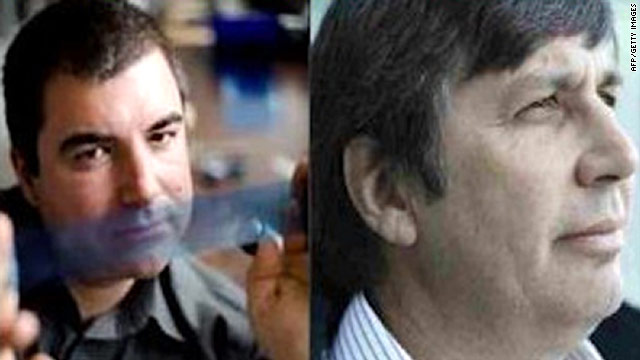
Konstantin Novoselov and Andre Geim received the Nobel prize for physics for their work with Graphene.
Feeding into the economy over a ten year period, the money has been awarded to the Graphene programme led by theoretical physicist Jari Kinaret at Chalmers University of Technology in Gothenburg, Sweden. An initial award of 54 million Euros will be made over the next 30 month in order to ramp up the current levels of research and development.


Speaking of how industry is central to the Eurpeon intiative, Professor Kinaret has commented,
“The involvement of industry can be divided into three elements. There is a management component, where three of the nine seats on our strategic advisory council are filled by the industrial sector in the form of Nokia, Airbus and Texas Instruments. Then there is a larger group of companies who are research partners and who account for at least 14 percent of the total budget; a figure which could increase to almost 30 percent after open applications have been received.
Thirdly, there is a group of companies who want to monitor development but are not persuaded that the technology is mature enough yet for them to enter the field themselves in terms of research. These include AB Volvo and Autoliv.
The whole idea is that academia and business will work better together. In Europe we are strong in research, but up to now we have been less successful in deriving financial benefit from research than our counterparts in Asia and the USA… This is commonly referred to as the European paradox. This is what our flagship is trying to address. If we succeed, the entire “European fleet” will benefit.
The most rapid breakthroughs will be seen in the field of printable and flexile electronics. The advantages in this field are huge compared with existing technology. It is estimated that the market will be worth USD 60 billion a year by 2020, of which more than half will be in flexible electronics. In the USA, graphene is already being used in packaging material which alerts when someone tries to break it open.”

The support coming from the European Commission is only one of the fronts on which the graphene industry is being financed. As commented on in earlier articles, the UK government is also pledging its support by way of a £21 million package of investment that will see several universities benfiting.

Receiving the lion’s share of the money is Cambridge University, who have today announced the construction of a £12 million specialist research centre. The Cambridge team of scientists are involved in researching graphene flexible electronics and opto-electronics, which could include things like touch-screens and other display devices.

And you wil not have to wait long for the work at  the Cambridge Graphene Centre to commence; it is planned that the centre will start its activities on February 1st 2013, with a dedicated facility due to open at the end of the year.

Professor Andrea Ferrari, who will be the Centre’s Director, said:
“We are now in the second phase of graphene research, following the award of the Nobel Prize to Geim and Novoselov. That means we are targeting applications and manufacturing processes, and broadening research to other two-dimensional materials and hybrid systems. The integration of these new materials could bring a new dimension to future technologies, creating faster, thinner, stronger, more flexible broadband devices.”
The centre will initially focus on improving the chemical vapour deposition production of graphene and will hopefully open up a wide avenue of possibility in terms of future devices and applications.
The remainder of the investment coming from the UK is to be divided amongst the other universities. Imperial College London will receive over £4.5m to investigate aerospace applications of graphene whilst the other successful projects are based at Durham University, the University of Manchester, the University of Exeter and Royal Holloway.

The universities will themselves contribute about £2m to the overall effort, and will work with industrial partners including Nokia (NYSE: NOK) , BAE Systems  (LSE: BA.L), Procter & Gamble(LSE: PG), Qinetiq(LSE: QQ), Rolls-Royce (LSE: RR.L), Dyson (LSE: DYS), Sharp (6753.T) and Philips Research (NYSE: PHG)- the pooled resources of which will add a further £12m in investment.

Clearly, the strategic response within Europe to the paradox of under commercialisation will take several years to bear fruit. Whether the response to the growth of the graphene industry has been swift enough will be decided, to some extent, by the speed with which Europe manages to claw its way back up the table of world patents. Whatever happens, Europe government, and a small clique of European companies, have nailed their colours to the mast of the graphene industry. The potential of the material is obvious, all we need to do know is make it pay.
Sources:
Cambridge University
Nature
Chalmers University
BBC

Thursday, December 29, 2011

Naysayers and famous quotes from critics who just couldn't see possibility!

InnovationImage via Wikipedia
NAYSAYERS PROVEN WRONG...


"Man  will never reach the moon regardless of all future scientific  advances."
--        Dr. Lee DeForest, "Father of Radio & Grandfather        of Television."
~~~~~~~~~~~~~~~~~~~~~~~~~~~~~~~~~~~~~~~~~~~~~~~~~~~~~~~~~
"The  bomb will never go off. I speak as an expert in explosives."
  -        - Admiral William Leahy , US Atomic Bomb Project
~~~~~~~~~~~~~~~~~~~~~~~~~~~~~~~~~~~~~~~~~~~~~~~~~~~~~~~~~
"There is no likelihood man can ever tap the power of the atom."
--        Robert Millikan, Nobel Prize in Physics, 1923
~~~~~~~~~~~~~~~~~~~~~~~~~~~~~~~~~~~~~~~~~~~~~~~~~~~~~~~~~
"Computers in the future may weigh no more than 1.5 tons."
--        Popular Mechanics, forecasting the relentless march of science,        1949
~~~~~~~~~~~~~~~~~~~~~~~~~~~~~~~~~~~~~~~~~~~~~~~~~~~~~~~~~
"I  think there is a world market for maybe five  computers."
--        Thomas Watson, chairman of IBM, 1943
~~~~~~~~~~~~~~~~~~~~~~~~~~~~~~~~~~~~~~~~~~~~~~~~~~~~~~~~~
"I have traveled the length and breadth of this country and talked with the  best people, and I can assure you that data processing is a fad that won't last out the year."
-- The editor in charge of business books for Prentice Hall, 1957
~~~~~~~~~~~~~~~~~~~~~~~~~~~~~~~~~~~~~~~~~~~~~~~~~~~~~~~~~
"But what is it good for?"
--        Engineer at the Advanced Computing Systems Division of IBM, 1968,        commenting on the microchip.
~~~~~~~~~~~~~~~~~~~~~~~~~~~~~~~~~~~~~~~~~~~~~~~~~~~~~~~~~
"640K ought to be enough for anybody."
--        Bill Gates, 1981
~~~~~~~~~~~~~~~~~~~~~~~~~~~~~~~~~~~~~~~~~~~~~~~~~~~~~~~~~
This 'telephone' has  too many shortcomings to be seriously considered as a means of communication. The device is inherently of no value to us."  
--        Western Union internal memo, 1876.
~~~~~~~~~~~~~~~~~~~~~~~~~~~~~~~~~~~~~~~~~~~~~~~~~~~~~~~~~
"The Wireless music box has no imaginable commercial value. Who would pay for a message sent to nobody in particular?"
--        David Sarnoff's associates in response to his urgings for investment in the radio in the 1920s.
~~~~~~~~~~~~~~~~~~~~~~~~~~~~~~~~~~~~~~~~~~~~~~~~~~~~~~~~~
"The concept is interesting and well-formed, but in order to earn better than a  'C', the idea must be feasible."
--        A Yale University management professor in response to Fred Smith's paper proposing reliable overnight delivery service. (Smith went on to found Federal Express Corp.)
~~~~~~~~~~~~~~~~~~~~~~~~~~~~~~~~~~~~~~~~~~~~~~~~~~~~~~~~~
"I'm just glad it'll be Clark Gable who's falling on his face and not Gary Cooper."
-- Gary  Cooper on his decision not to take the leading role in "Gone With The Wind."
~~~~~~~~~~~~~~~~~~~~~~~~~~~~~~~~~~~~~~~~~~~~~~~~~~~~~~~~~
"A cookie store is a bad idea. Besides, the market research reports say America likes crispy cookies, not soft and chewy cookies like you make."
--        Response to Debbi Fields' idea of starting Mrs. Fields'        Cookies.
~~~~~~~~~~~~~~~~~~~~~~~~~~~~~~~~~~~~~~~~~~~~~~~~~~~~~~~~~
"We don't like their sound, and guitar music is on the way out,"
--        Decca Recording Co. rejecting the Beatles, 1962.
~~~~~~~~~~~~~~~~~~~~~~~~~~~~~~~~~~~~~~~~~~~~~~~~~~~~~~~~~
"Heavier-than-air flying machines are impossible,"
--        Lord Kelvin, president, Royal Society, 1895.
~~~~~~~~~~~~~~~~~~~~~~~~~~~~~~~~~~~~~~~~~~~~~~~~~~~~~~~~~
"If  I had thought about it, I wouldn't have done the experiment. The literature was full of examples that said you can't do        this,"
-        - Spencer Silver on the work that led to the unique adhesives for 3-M  "Post-It" Notepads .
~~~~~~~~~~~~~~~~~~~~~~~~~~~~~~~~~~~~~~~~~~~~~~~~~~~~~~~~~
"Drill for oil? You mean drill into the ground to try and find oil? You're crazy,"
--        Drillers who Edwin L. Drake tried to enlist to his project to drill for  oil in 1859.
~~~~~~~~~~~~~~~~~~~~~~~~~~~~~~~~~~~~~~~~~~~~~~~~~~~~~~~~~
"Stocks have reached what looks like a permanently high plateau."
--        Irving Fisher, Professor of Economics, Yale University , 1929.
~~~~~~~~~~~~~~~~~~~~~~~~~~~~~~~~~~~~~~~~~~~~~~~~~~~~~~~~~
"Airplanes  are interesting toys but of no military value."
--        Marechal Ferdinand Foch, Professor of Strategy, Ecole Superieure de Guerre        , France .
~~~~~~~~~~~~~~~~~~~~~~~~~~~~~~~~~~~~~~~~~~~~~~~~~~~~~~~~~
"Everything  that can be invented has been invented."
--        Charles H. Duell, Commissioner, US Office of Patents, 1899.
~~~~~~~~~~~~~~~~~~~~~~~~~~~~~~~~~~~~~~~~~~~~~~~~~~~~~~~~~
"The super computer is technologically impossible. It would take all of the water that flows over Niagara Falls to cool the heat generated by the number of  vacuum tubes required."
-- Professor  of Electrical Engineering, New York University
~~~~~~~~~~~~~~~~~~~~~~~~~~~~~~~~~~~~~~~~~~~~~~~~~~~~~~~~~
"I  don't know what use any one could find for a machine that would make copies of documents. It certainly couldn't be a feasible business by itself."
--        the head of IBM, refusing to back the idea, forcing the inventor to found Xerox.
~~~~~~~~~~~~~~~~~~~~~~~~~~~~~~~~~~~~~~~~~~~~~~~~~~~~~~~~~
"Louis  Pasteur's theory of germs is ridiculous fiction."
--        Pierre Pachet, Professor of Physiology at Toulouse , 1872
~~~~~~~~~~~~~~~~~~~~~~~~~~~~~~~~~~~~~~~~~~~~~~~~~~~~~~~~~
"The abdomen, the chest, and the brain will forever be shut from the intrusion of the wise and humane surgeon."
--        Sir John Eric Ericksen, British surgeon, appointed Surgeon-Extraordinary to Queen Victoria 1873.
~~~~~~~~~~~~~~~~~~~~~~~~~~~~~~~~~~~~~~~~~~~~~~~~~~~~~~~~~
And last but not least

"There is no reason anyone would want a computer in their  home."
--        Ken Olson, president, chairman and founder of Digital Equipment Corp.,  1977
~~~~~~~~~~~~~~~~~~~~~~~~~~~~~~~~~~~~~~~~~~~~~~~~~~~~~~~~~
Enhanced by Zemanta